SHOW NOTES - TRANSCRIPT

Please note: This transcript was produced with the help of Otter. Corrections have been made although it is not perfect.
Mark Jesser: I've borrowed you from your stand at the N Scale Convention in Adelaide. How's it going so far?
Jarryd Langford: Yeah, it's actually going really well so far. Yeah, we've hit the ground running. Good couple of purchases happening, and seeing a couple of familiar faces. So yeah, it's been a great start.
Mark Jesser: And thanks for your time. I know you've got a lot of people coming up to your stand, wanting to have a bit of a chat. So, for for people that don't know you, where are you based?
Jarryd Langford: Yeah, I'm based in South Sydney, in New South Wales, in Australia.
Mark Jesser: And where did where did train start for you?
Jarryd Langford: Yeah, train started for me virtually straight out of the womb. I think really, my my dad has always been a bit of a a um keen train fan, and he's here with me this weekend as well, as he is with with me at most of the different events we attend. Um, so yeah, really from a very young age, you know, the wooden trains on the on the track,that kind of thing. Pretty much started there, and um, found more valid excuses to keep doing it as I get older, and you know, make make sure you do it properly so you don't look like a child or something. Not there's anything wrong with that, but yeah.
Mark Jesser: And how good is it to sort of go to shows with your old man?
Jarryd Langford: Yeah, really good. It's it's yeah, we get to spend some really good time together. So we yeah we both really enjoy it. Yep.
Mark Jesser: and and traveling all around the countryside.
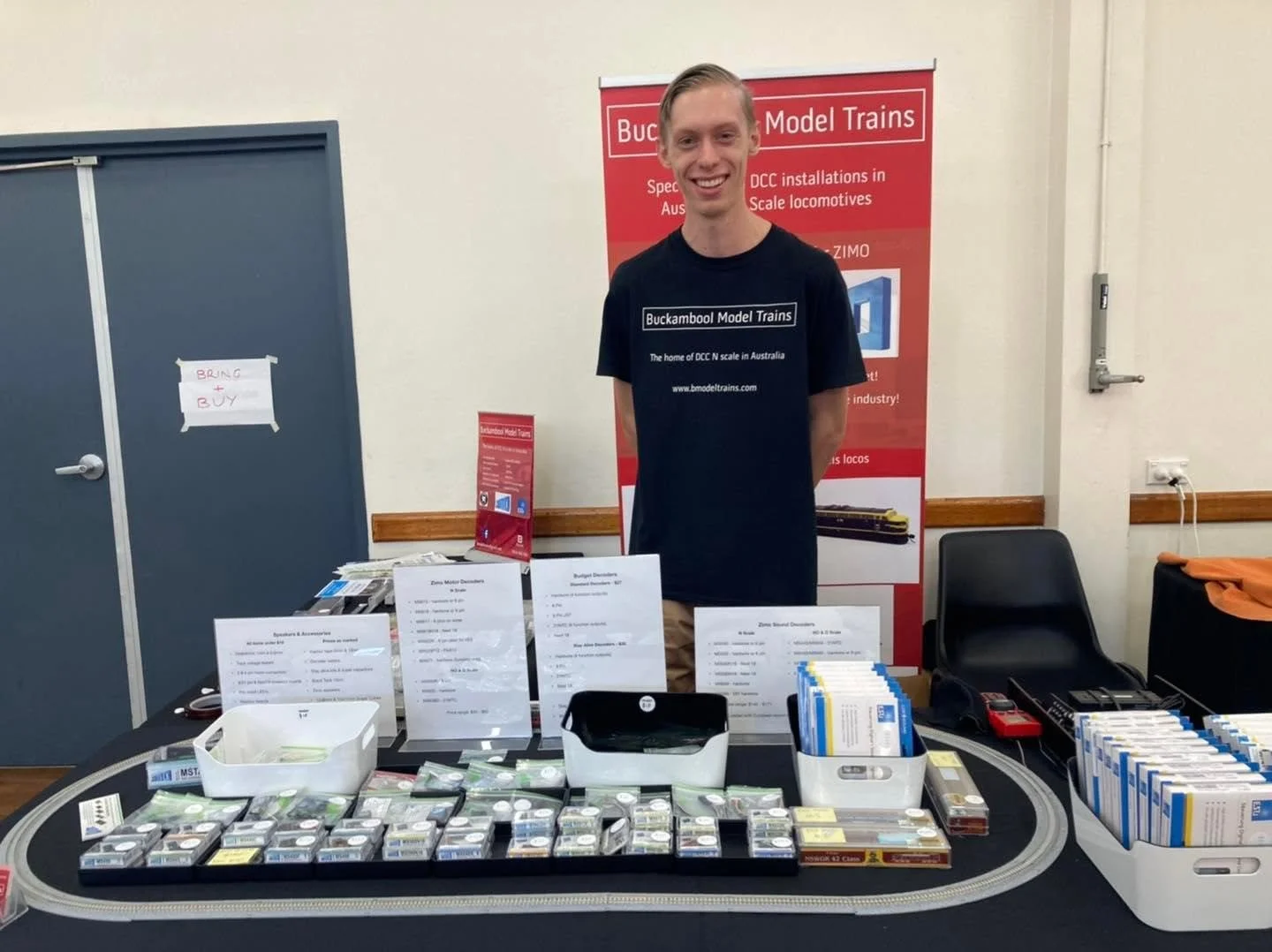
Jarryd setup at exhibitions
Jarryd Langford: Yeah, yeah, no, it's good fun. Yeah, we um, it's been a rare treat for us this weekend. We flew in,which has been quite nice. But yeah, normally we're in the car, lots of time to chat, um, and you know, catch up on things and find out about what each other's been doing, and just yeah, just good father and son times. Great. Yeah.
Mark Jesser: And I believe work for you now is Buckambool Model Trains.
Jarryd Langford: Yeah, yeah. This is full time. Yep.
Mark Jesser: Wow. How how good's that?
Jarryd Langford: Yeah, it's it's it's pretty cool. Definitely not what I imagined I would have that I'd be doing. You know, even a couple of years ago, really. Yeah, it's it's amazing. Really. Yep.
Mark Jesser: And for people that don't know, tell us a little bit about Buckambool Model Trains.
Jarryd Langford: Yeah, so we specialize in DCC for N Scale. So that looks like products that we sell. We offer, we do a lot of installations of DCC decoders for for people into their trains, and then we're sort of growing on the side with a growing range of products, not necessarily always DCC, but always N Scale, and yeah, in the Australian N Scale space.Yep.
Mark Jesser: What what was work for you before taking on Buckambool Model Trains full time?
Jarryd Langford: Yeah, so I trained as a high school music teacher at uni, and I I did end up working in that space for a couple of years. Buckambool actually started while probably yeah right at the start of like when I started uni. So I started it very very small scale operation at the start of uni, and then by the time I'd left uni, it was it was really a part time job. So yeah, did a couple of years of teaching and realized I kind of had to pick one or the other to to continue with in a full time capacity. It was just you know both were demanding my time too much. It's just not possible to keep doing both. So that's that's where we ended up. So
Mark Jesser: how hard was that transition from being music teacher to doing your own thing,
Jarryd Langford: yeah, yeah. To be honest, it was relatively easy in that I was already doing it. Just it just meant I had like another two to three ish days a week to to do what I was already doing, and that was a real blessing, really. In that I was just trying to cram in so much stuff before, so yeah, just it gave me the time to actually do what I was wanting to do properly, and you know, get back on track with installations and things that were become too overdue and all things like that. So
Mark Jesser: yeah, and what what does your sort of working week look like?
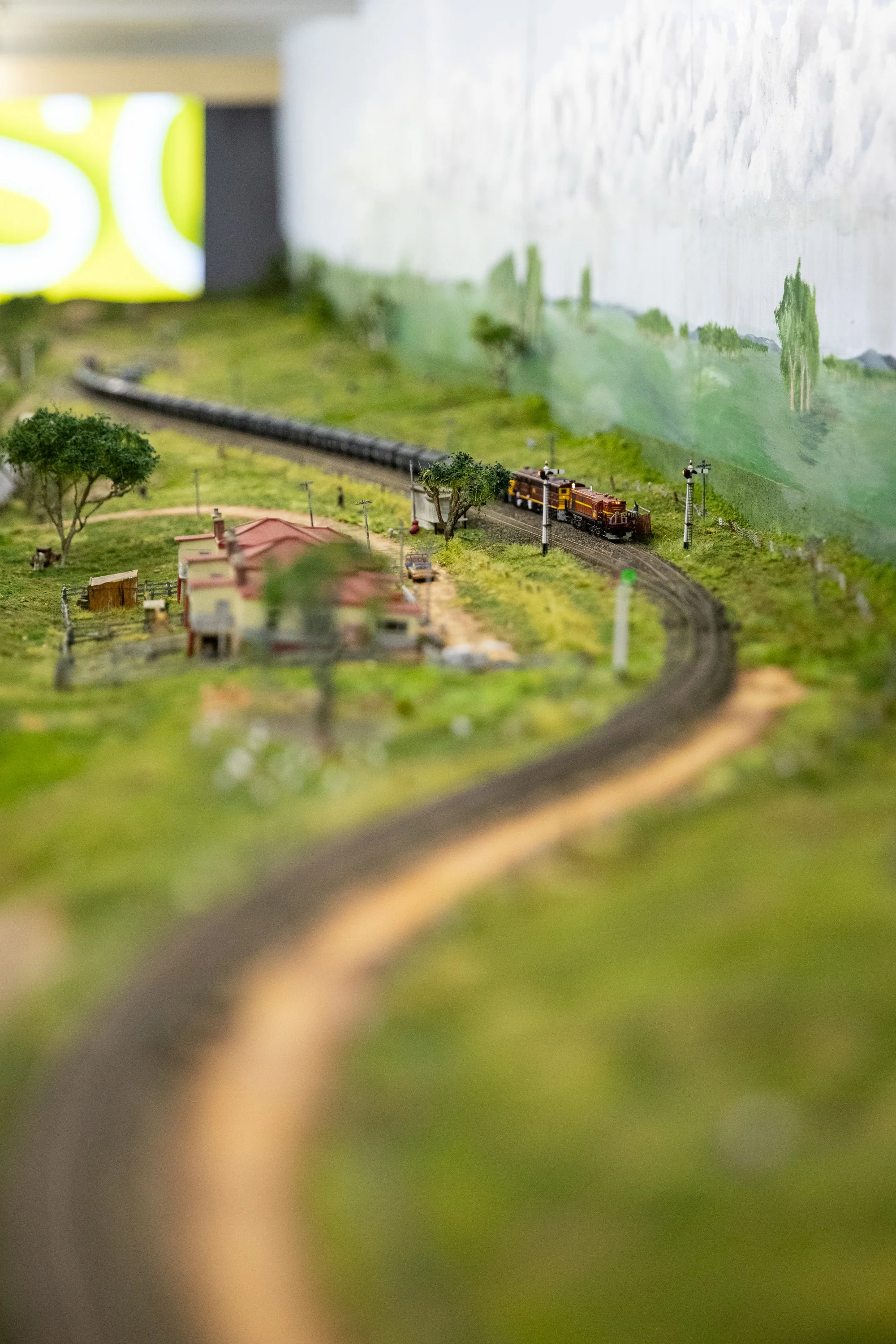
Gresham by Sydney N
Jarryd Langford: Yeah, generally like Mondays and Wednesdays, it's very much where you know packing retail orders so that we we get a lot of people buying product through our website. So often a lot of that does occur over the weekend. So Monday sort of hit the ground running and getting orders out the door. My wife works with me now as well as part of the business, so she's she's actually pretty much in charge of shipping everything out on Mondays and Wednesdays, and I just sort of support her in that capacity. But yeah, we often get a lot of email inquiries and phone calls.
Those sort of days we're sort of doing retail and and and and communicating with with people who are inquiring about product. The other days of the week, generally more so, I you know get get a bit more time to myself to sit there do decoder installs for people. Those are sort of you know so Tuesdays, Thursdays, and often Fridays as well. Get to do a lot of um yeah the installs for people, and that's it's always different. One day I might be doing O scale. One next day I might be doing a couple of HO locos. But yeah. Most of the time, we do try and focus on doing N Scale installations,and often not. It's Australian N Scale that we're working on. So yeah, yeah
Mark Jesser: nice, nice. And in and in terms of you personally, like, are you spending much time modeling yourself?
Jarryd Langford: Yeah, I'd I'd love love to say yes. I'm spending heaps of time, but yeah, in recent times, not so much. But yeah, still, you know, I find the occasional moment to to do something, to work on something. So yeah, when when it when and where I can find time in amongst busyness of life and young family, everything. I've I've got a young son,so yeah. Do you have your own layout? So technically, yes. I've got a somewhat recently moved house, and and I did was was lucky I was able to expand my home test layout. So now I can run a train in a circle, and it's a fairly largeish folded dog bone, essentially. So a lot of it is just atomic set track and things like that. So it's nothing pretty, no scenery or anything like that. But yeah, I can run a reasonable train. The other part of the answer to that question is a lot of people often ask me this question. I am a part owner of Gresham, which is an exhibition layout, so I do technically class that as my own layout. It lives at Sydney and Scale Club, but yeah, get to get to play on that semi frequently and run some trains through nice scenery and that. And Western New South Wales, that layout is set. So yeah, that's that that one I quite like too.
Mark Jesser: Yeah, nice. You've um you've bounced a little bit forward for me, which is great. But how big is Gresham?
Jarryd Langford: Yeah, Gresham is if I get it correct, I believe it is 4.8m x 1m, pretty approximately. So
Mark Jesser: and um I've seen that out on the exhibition circuit a few times. It's
Jarryd Langford: it's been
Mark Jesser: around for a little while. Yes. For people that don't know, how many sort of pieces is it? What's it sort of? How hard is it to transport?
Jarryd Langford: Yeah. So it's an interesting layout in that it breaks into four pieces, each are 1.2 meters long, and that's that's it comprises both the front scenic section and the fiddle yard section in those pieces, and and the way we transport it is the fiddle yard folds on top of the on top of the scenic section at the front to form a kind of a suitcase or a closed up module, and then we sort of bolt it together to protect it and things like that. So yeah, it folds up quite nicely,just sits on like adjustable legs, and then we've got some. It does sit in sort of a full picture box style, you know,backdrop and and roof, I guess, for it and lighting are incorporated into that. So they sort of have to be broken up into pieces as well. But yeah, it's quite transportable. I can fit it into the back of my Ute nearly in its entirety. So yeah,
Mark Jesser: I've seen the layout many times. It shows and always been very impressed by the fact that it's sort of a little bit different in terms of its its track configuration around the front. Can you tell me what makes it unique?
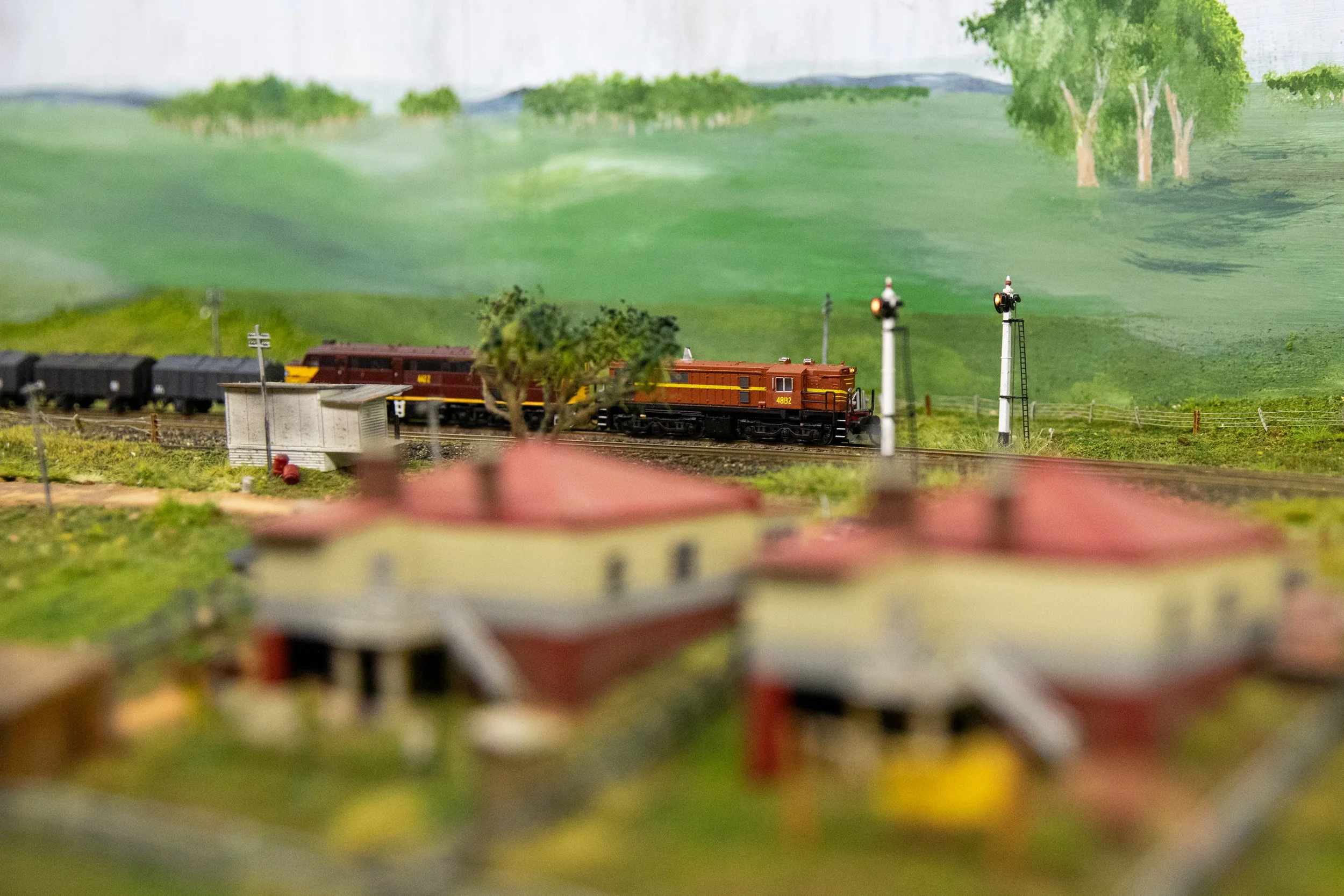
Jarryd Langford: Yeah, so it's at one end, it's double track, and at the other end, it's single track. So it, yeah, it presents differently. It's also got quite large S curves through through the entire front of it as well. So it's a bit different to your traditional sort of double track main line that's relatively straight across the front of the layout. So yeah, and to operate it is quite difficult. You got to really keep your wits about it, particularly with that single track end.
Mark Jesser: And and you've sort of got to have two people sort of keeping an eye on it the whole time at the front,don't you?
Jarryd Langford: Yeah, definitely. Yeah, we usually have an operator running trains in one direction at one end, and then you'll have at the opposing end, you'll have another operator running trains the other way, and yeah, it's got semaphore signals on there, so you've really got to follow the signals. The signals are interlocked with the points, and is sort of the key in in as to how you navigate the single track section.
Mark Jesser: And you sort of were the mastermind behind the semaphores to get them to move.
Jarryd Langford: I yes, I was a little bit yes, yeah. In reality, it's a fairly simple Arduino sketch, which interlocks servos, which control the the which are used for point motors, and then yeah, they're Dapol semaphore signals, which are close enough. They're not exactly correct, but they're close enough for New South Wales prototype signals. So, yep.
Mark Jesser: And you did you design the coding sort of behind that?
Jarryd Langford: Yeah, I manipulated the code, so I got a lot of the code from DIY Digital, the YouTube channel where Jimmy on there he's. Done a lot of work with Arduinos and signaling and different things like that. So I sort of inherited his code and then manipulated it to to work as to how we needed it. And then yeah, I think in the end it probably got quite heavily modified to to to do what we wanted it to do. So
Mark Jesser: and was that always sort of the plan to have that sort of system running alongside the trains,
Jarryd Langford: yeah, I believe so. I mean, I think the the just the idea of Gresham was the the beginning, but then yeah, quite quickly, a couple of the other I believe it was a couple of the other guys involved with the layout. They they do a bit of British N Scale or N gauge, and they were aware of the signals, so it was quite quick. They went, "Oh,actually, be quite a nice idea if we incorporated signals, as we yeah like to like to sort of push the envelope a little bit with things we do. We don't. We sort of yeah like to do things that are a bit different, things that might not have been done before.
So as soon as I saw that, went yeah, that's that's a great idea, and we started immediately thinking about how we could make it work and what would be the simplest way to control it. So in in reality, it just works with two push buttons. We we push one button to change the point from for for either line, the up or the down line, or the Sydney or Blaney running. That there's one button that just controls that, and then there's another button that controls a crossover, which is a little bit further down the line, and then every all the signaling and everything just just works off of that. So it keeps it simple for the operators.
Mark Jesser: And any other projects that you've sort of been working on with the Arduino side of things?
Jarryd Langford: Yeah, to be honest, yeah, not really. The only thing that I have done is we recently added on the topic of Gresham, we added a a lightning and thunder sort of type effect to Gresham, and that is a little Arduino project.I I can take no credit for that because I found it online and completely copied it, modified nothing. All I did was just added a couple of thunder sort of MP3 clips into the yeah into the sort of the hardware that runs that. But yeah, it's it just comprises of a couple of couple of sort of LED strips that that flash for your for your lightning, and then yeah, the Arduino triggers a little MP3 player that just randomly plays some thunder sounds, so it's just something we wanted to add. Just something different.
We wanted to add to the layout to give it a little bit more, yeah, a little bit more effect or whatever. As yeah, that the the whole sort of modeling of the layout is meant to be that it's it's sort of either during or after a storm. We've got quite a few little puddles and things modeled and stuff like that. So, and it's quite a an interesting place for weather. Weather is quite extreme out there. So,
Mark Jesser: nice, nice. Yeah, sticking with the the prototype.
Jarryd Langford: Yes, yes, yeah. I've I've always joked that we should get a you know a big inverter air conditioner and stick it on the front and have some misters there, putting out water and and freezing cold air, and then it would be very prototypical for you know the middle of winter out at Gresham.
Mark Jesser: That's awesome. Yeah, it'd
Jarryd Langford: be it'd be pretty different, you know, a bit like the the 4d cinemas or whatever you know they have out there. Yeah, really, really
Mark Jesser: feel Gresham when you come to when you come to look at it, yeah,
Jarryd Langford: yeah, yeah
Mark Jesser: Going back to yourself and projects you've done, you recently did a ready-to-run wagon.
Jarryd Langford: Yep,
Mark Jesser: tell us a bit about that.
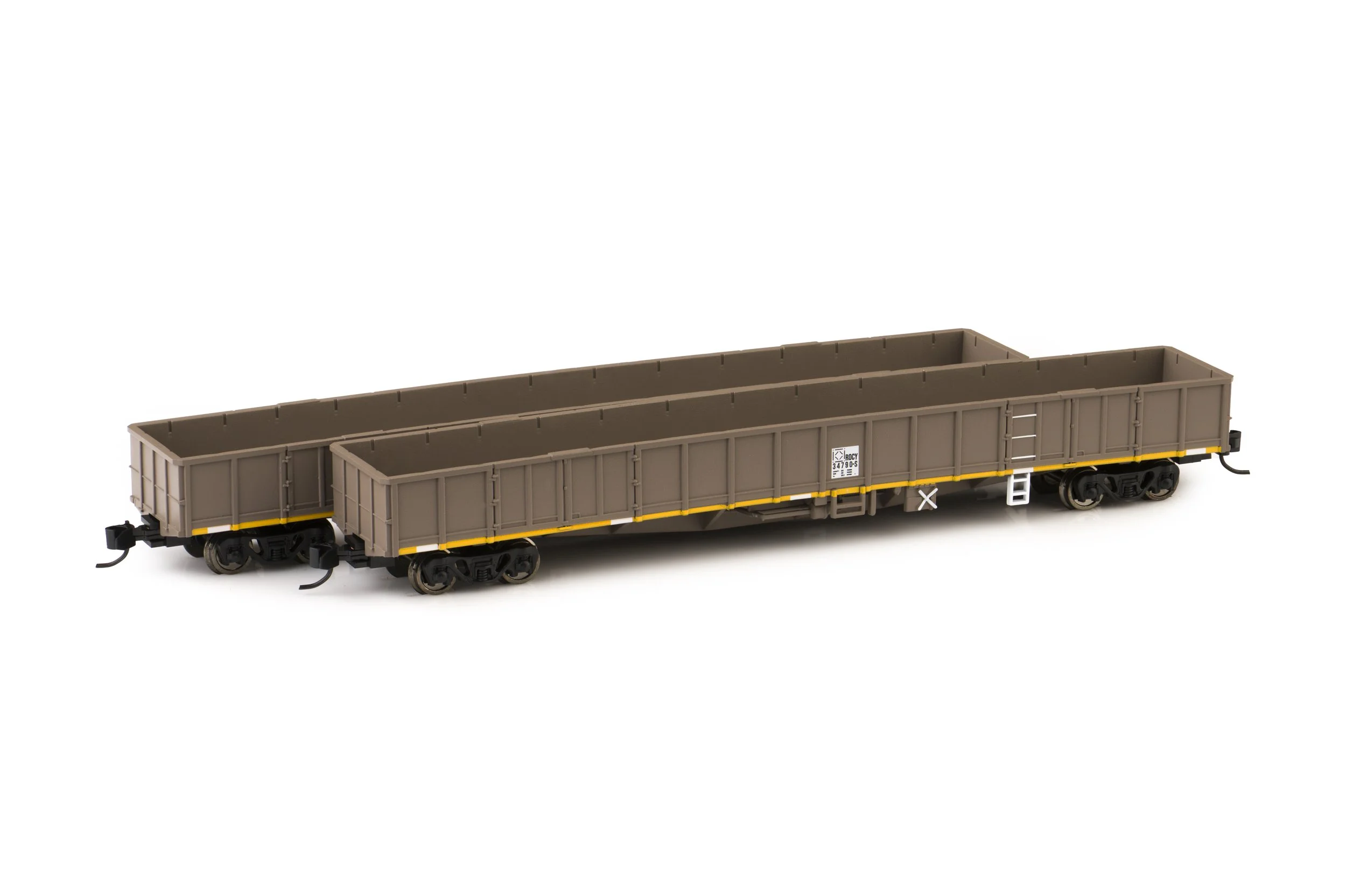
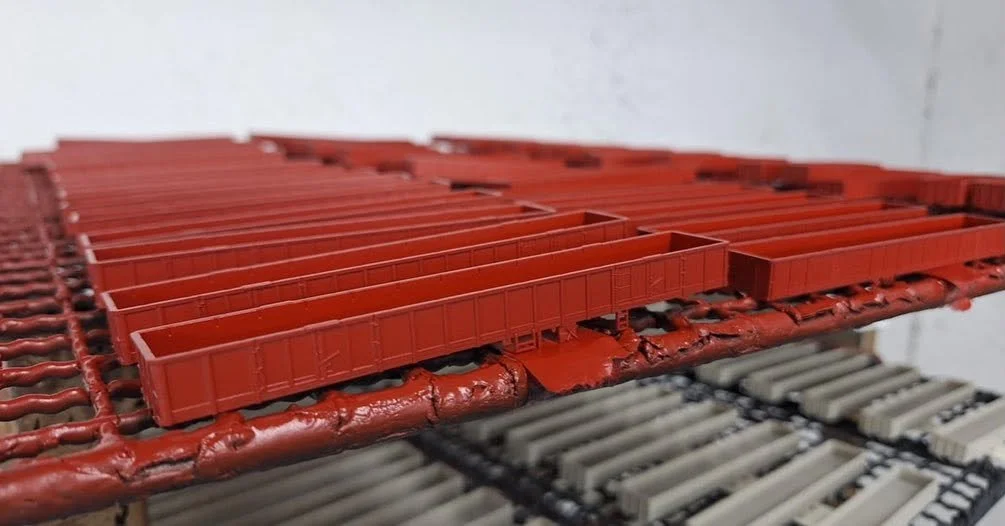
Jarryd Langford: Yeah, yeah. So, yeah, for for quite a while, I've wanted to to do something ready to run. I've I've worked quite closely with Gopher models and helping them sort of do some projects and things for for a good couple of years now. So sort of got a bit of a taste for it and and wanted to to have a go myself. Just basically challenge myself and and give it a go and yeah, just jump sort of straight in and and found a thought a an open wagon hasn't been done.
You know, there's been sort of coal hoppers and wheat hoppers and a few other bits and container wagons and a few other bits and pieces have been done. So just yeah, tried to find something that's a bit different and also something that I know I could something that was relatively simple and wouldn't cost the earth to do as well. So yeah,
Mark Jesser: how has that been received?
Jarryd Langford: Yeah, really well. Like, I'm very, very grateful for the for the the positive reception they've they've had in terms of you know people coming up and buying them and positive comments and things like that. It's been really, really nice. Very grateful for it. Yeah, we're we've we've sold out of one version, so the Pacific National version sold out, probably going back a couple of months ago now, and a few other of the there was about 10 types in total. A couple of other other types are sort of on the way to getting to that point, and yeah, quite a few hobby shops were. I approached quite a few hobby shops to see if they were keen to stock them, and and they. Yeah, they were quite keen to stock them. So yeah, it's been it's been great.
Picture by Mark Jesser
Mark Jesser: And for people that don't know, like what sort of run have you got to do for something like this? Like,how how many have you got to sort of try and move?
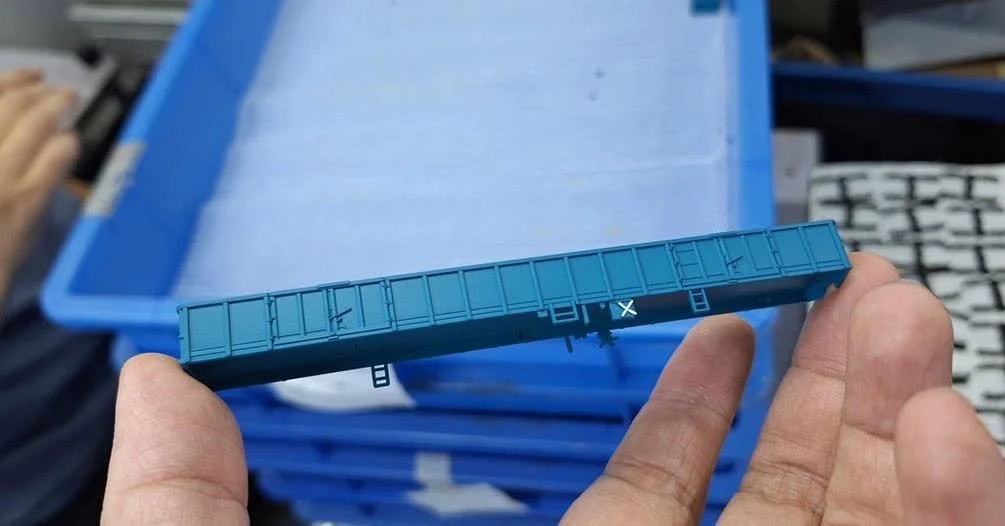
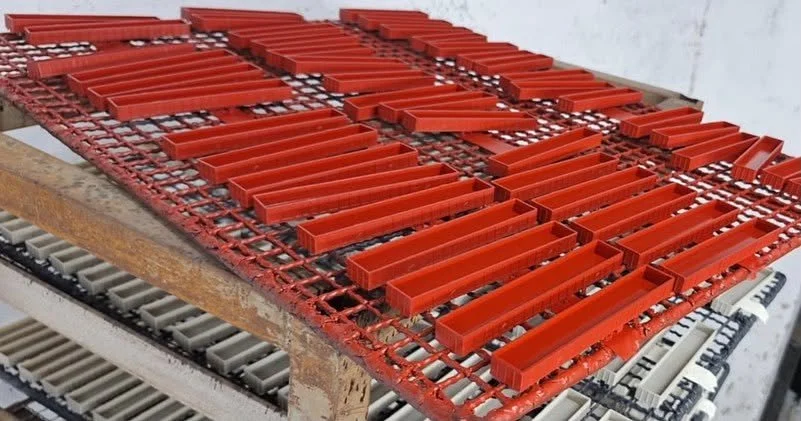
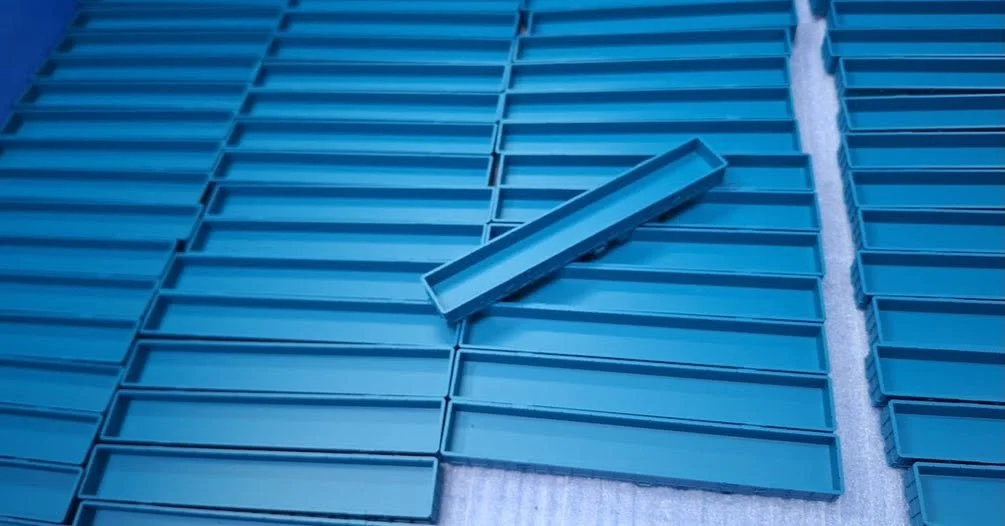
Jarryd Langford: Yeah, yeah. So the the factories always have minimums, but there's also just sort of a you've you've got to pick a number that's because you've got your tooling costs, so there's a that's a fixed cost to to create the the molds and dies and things like that to actually produce the wagon. So it's it's balancing that against then the the production costs that the factory gives, which is a sort of a per unit cost. So it's a balancing act between getting those to a point where, when you you pick a certain quantity, the numbers come out right for for a retail margin and then a wholesale margin as well. So in the end, we we decided on we were looking initially at doing 1500, but the numbers just worked out better. You know, to spend a little bit more and go up to do 2000 wagons. So we did 2000, and yeah,that got us to a point where we could we could set a reasonable what we thought was a reasonable retail price for the the end customers, and then also retain a somewhat reasonable wholesale margin where yeah we could still make a little bit we we yeah we did sort of sacrifice ourselves a little bit on the the wholesale margin otherwise it yeah just would have blown the retail price out too much you sort of got to work on the on sort of a rule of thirds like the factory gets a third then there's another third and that's the wholesale, and then there's another third, and that's that's your retail, and then you've you've got to work in just your GST in there as as well at the end. So,
Mark Jesser: and you're selling them in a a two pack. Is that is that 2002 pack, or is that?
Jarryd Langford: Yeah, no. So it's actually 2000 wagons total. So it's 1002 packs, yeah.
Mark Jesser: And and in terms of those, you know, your different color schemes, was there one that you sort of didn't do, or like how did you sort of go picking?
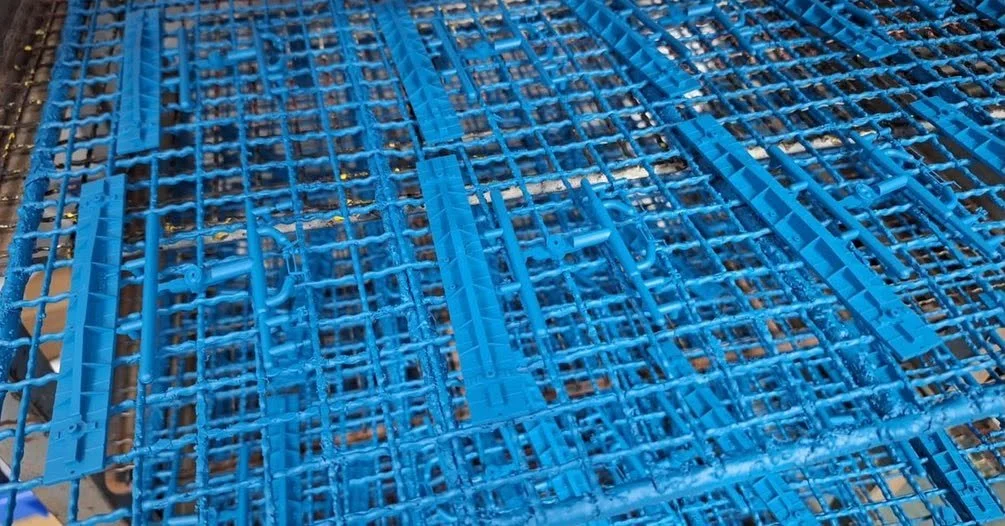
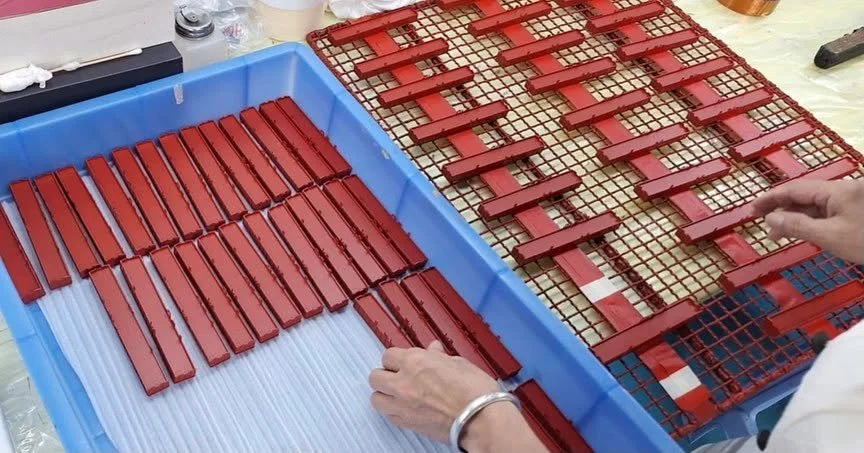
Jarryd Langford: Yep. Yes. So we we deliberately didn't do the C train version, which was a number of people did request that as it would have been another like tooling variation essentially, which would have added a considerable cost. There's basically a yeah big sort of panel or plate down the side of the wagon that they yeah they then apply a Sea Train logo to. So yeah, we had to unfortunately miss out on that one, but we did actually do two body styles. The we did three paint schemes of the ROCY, which is very similar to then the CDY NOCY, which is the other version. The only difference really is just door latches on them for the RO. When they converted them to the ROCY, ultimately,yeah, they removed a lot of the the door latches and things like that. So it's a minor detail, but it was actually a yeah did did require different tooling. So that did did add some cost, but yeah, we saw it was it was worthwhile doing that. So yeah, there was yeah there's 10 different versions done and quite a few different paint schemes across it. We wanted to create, you know, lots of different colorful options. There's blue ones and red ones and black ones, and yeah, a few other colors in between. So
Mark Jesser: yeah, awesome. And are you looking at doing more in the ready to run space?
Jarryd Langford: Yeah, so we we definitely are. I can confirm that we have another wagon on on the way, and just just the other week we confirmed the go ahead with the factory on that one. So I'm not at liberty to disclose that one just yet,but keep an eye out. Once we get toolled samples, we will we will announce that.
Mark Jesser: Is this an exclusive for the podcast or?
Jarryd Langford: Yeah, pretty much. Yeah, yeah, yeah. We've only only sort of told a couple of people outside, but yeah, we haven't officially announced anything yet. Yeah, so you heard it here first.
Mark Jesser: Awesome, awesome. We spoke before about Gresham and and how it's linked to Sydney N. For people that don't know, what is Sydney N?
Jarryd Langford: Yeah, so Sydney N is formerly the Sydney N Scale Model Railway Club. It's basically just a model train club that specializes in N Scale. It can be yeah Australian, American, British, Japanese, European. You know anything N Scale goes. We're a club that just yeah we want to you know foster the interest of N Scale. Whilst we talk here at the National N Scale convention, it was actually a couple of members of Sydney N many years ago that started the first ever N Scale convention here in Australia. Yeah, so yeah, there's there's a lot of history with Sydney N. It's been. A number of quite a number of locations within the city of Sydney, but yeah, we do have a physical premises, and we at least it started as a modular club. But at least these days, we we focus on having a main fixed layout, and we and the club's fundamentally built around. We have a number of quite a large number of members, and they come and they run their trains. It's a great place just to come and run your trains, and we do also have a number of exhibition layouts. So we like to attend exhibitions, and yeah, we we have a considerable number of exhibition layouts and more to come.
Mark Jesser: and I've visited the the headquarters before. Yes, it's massive, like in terms of the the layout that that's fixed in there, it's it's massive. Yeah, how big is
Jarryd Langford: it? I believe now, if I remember this correctly, when it is finished and it is close to being finished,it'll be about a 60 scale kilometer run across the total main line, and there are other other parts to the layout as well.We've got quite a fairly large branch line and a few other sections. So, yeah, it's it's quite quite a large layout. Yeah, we think it could be either one of or the biggest N Scale layout in the country. And yeah, we're not sort of going for any records or anything. But yeah, we've got a large. We're very lucky to have a large space, and we thought, yeah, let's let's go for it.
Mark Jesser: And it gives you the ability to run some seriously long trains.
Jarryd Langford: Yeah, seriously long trains. So yeah, 90, 100 car coal trains, very very large trains. Yeah, there's there's sort of no restrictions on the length of trains, and if you're running something, it's only about 10 cars long. It looks quite small, so people, yeah, we the majority of our members are tending towards being you know American N Scale, and yeah, they they they will try and they often and the emphasis is on try. They will try to run quite regularly,you know, 3040, 50 car trains. Yeah,
Mark Jesser: and the layout's multi-layered too.
Jarryd Langford: Yeah, so it's a triple deck layout. The what we're working on at the minute is finishing off the. Well,it's not quite finishing off. We've we've made a good start on the top deck. The bottom and middle deck are fully complete, fully scenic, and yes, you can run between those two. There's there's two helixes that connects those two levels, and then we've got one of those helix which is also extending up to the third level at the minute.
Mark Jesser: Wow! Yeah,
Jarryd Langford: it's it's a it's a seriously big layout. Yeah, we're very lucky. We've we've had good contact with Sydney Water, so they look after you know all the sort of water and sewerage around the Sydney area, and we've occupied quite a number of Sydney water buildings over the years, and we've been very lucky to be given this building for considerable amount of time in terms of fixed leases and things. We have arrangements with them, so it's yeah, it's quite a large double brick ex Sydney Water like depot building. So our our main layout is built in the area where they used to park all their their big trucks and things like that. So it's a pretty large area.
Mark Jesser: And can people come and visit? How does that sort of work?
Jarryd Langford: Yeah, absolutely. We are very very very open to having visitors, and we highly encourage people to to come and have a look. You know, there's no sort of cost or anything like that. We're just all about promoting N Scale and and just having fun. To be honest, you know, no no politics or anything like that. Just just having fun with trains. So yeah, we are open most Saturdays. Sometimes occasionally with exhibitions on and things like that, we we don't open.But yeah, vast majority of Saturdays we're open from sort of you know 1011 o'clock in the morning through to you know four or five in the afternoon, and we're located in Rockdale in Sydney, so not not too far from the main Sydney airport. Yes, I believe the address is 75 Chapel Road, Rockdale,
Mark Jesser: and what does the membership look like?
Jarryd Langford: Yeah, so we've got about at the minute we've got about 50 or so members, and yeah, we're quite an active club. We sort of pride ourselves on that. We've we've probably got about maybe 10 to 15 members that are actively actually working on the the club layout and working at the club in terms of scenery, track work, electrical,building bench work, exhibition layouts, all that sort of stuff. And so we have a yeah good crew that's rocking up on Wednesdays as well. Sort of a you know bit of a retired gang of guys that come in on on a Wednesday and do some work, so
Mark Jesser: yeah, nice. Yeah, sounds good place to hang out.
Jarryd Langford: Definitely, definitely. Yeah, first and last Saturday of the month we have at the at the moment running days. So our members will come in and run trains. So they they're a good. That's sort of I guess the recommended days to come and visit because you'll. Actually, see us running some trains on the main layout, or maybe even some of the exhibition layouts. But yeah, we yeah we we we sort of pride ourselves on not sort of sitting around and talking all the time. Not that that's a bad thing, but we like to get things done. We like to get layouts built. We like to you know build extend layouts or you know work on improve them, whatever it be. Yeah, we've only been at Rockdale for I think since about 2019 or so, and in that time we've completely built the the main permanent layout to the to the state of where it is now. Yeah, the man hours put into it, I yeah couldn't even begin to start to count those as too many.
Mark Jesser: And and for you, like I definitely know my club. I've I've picked up you know a few bits and pieces for you. What have you sort of what have you picked up from being involved in Sydney? And
Jarryd Langford: yeah, I think really the main thing I've picked up just like purely you know skills based talking talking about skills would be wiring DCC and wiring for layouts. Prior to that point, I you know I could I could solder in decoders and all that sort of stuff, no problem. That was all all okay, and I knew a fair bit about you know different decoders and just how that just in the in the product space there, but I didn't know a whole lot about how to wire up a layout or the you know all the DCC components involved in setting up a you know and in in this case a very large club layout. So I learnt a lot in that space, and it's been quite helpful. As I I mean I I don't so much you know help people wire up their layouts as a service or anything like that. But quite often you get questions at shows or customers who you've done installs for, you know they're asking about how how you do X Y or Z on your layout in terms of wiring or what what do I need to purchase or what whatnot. So it's been really helpful for that, and I've been really keen to just try and share what I've learnt in that space, and I'm still learning as well. So, is
DCC-EX
Mark Jesser: there an example of where you've learned something that you think would be important to pass on to others
Jarryd Langford: Yeah, I think particularly in how you set up a DCC layout in terms of hardware, it is quite important to make sure you've got enough power available for a layout, and also how you go about planning out distributing that power around the layout. I think a lot of people, you know, I guess still need to learn that or haven't learnt that, and are curious on how to do that. So that that's been, I think, something that's been really important that I've I've learnt, and and I have already been able to share it with a lot of people from my experience of what I've learnt
Mark Jesser: in terms of the DCC and the wiring. Yeah, you're selling a bit of product around the DCC ex space.
Jarryd Langford: Yes,
Mark Jesser: how's that changed for you? Like controlling trains on your phone, is that something that you've seen?
Jarryd Langford: Yeah, it's something. I mean, talking, I guess, a little bit in the Sydney N side of things. When I first joined the club, well over 10 years ago, it was you know it was a Digitrax club. You had to buy a Digitrax throttle to run your train at the club, and that you know that was something that when both my dad and I joined at that time, that was what we did. Is what you had to do. There was no option of okay, you just whip out your phone and run a train or or whatnot. So yeah, DCCEX has has changed things quite a lot in that space. I mean, prior to DCCEX, you could start to do that with JMRI, you know, wire throttle servers and all these sorts of things. And there was a couple of other products that came on the market that let you do it, but then talking in the sense of my business, it did change things a lot for me. In that prior to that point, I didn't really have a DCC system that I was stocking, so I was selling decoders, I was installing decoders in trains, selling all the things around, particularly sound decoders, so things like speakers, day of lives, etc., etc., all the all the stuff you need, basically. But people would always ask, "Oh, you know," I often get asked, "Do you have a what DCC system do you recommend?
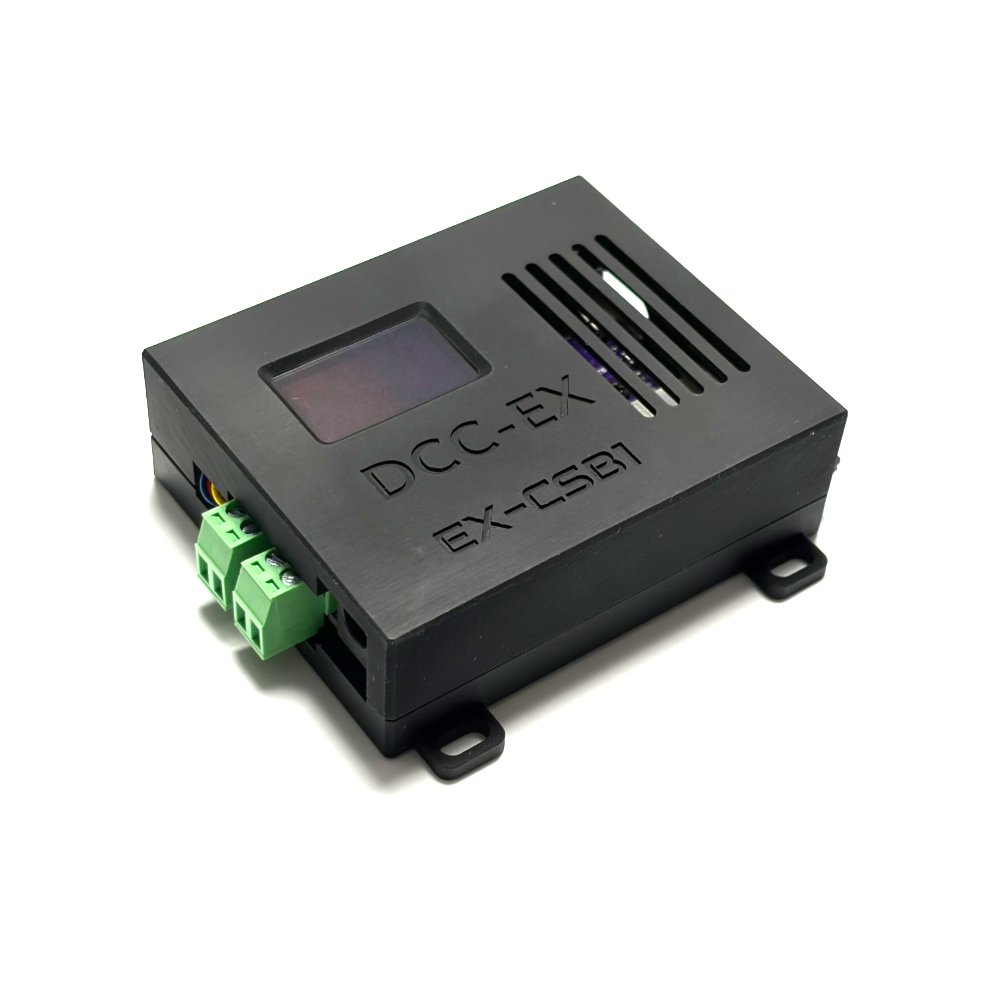
Do you sell one, etc., etc." So that changed things a lot for me. Is when I when I saw DCC EX, and then particularly the the CSB one, which is a ready-made command station.Prior to that point, DCCEX was all about you know people would build their own DCC system themselves. Once the that ready to run, I guess you could call it command station, the CSB one came onto the market. I saw that and went,yep, that's that's the system that I'd love to stock, and so that yeah, that changed things a lot for us. In that yeah, now we now we are able to to sell a DCC system, and we yeah highly recommend it. DCCEX is a it's an open source thing. I don't know what you'd exactly call it, but yeah, it's. What it is is a group of of people around the world, so from the UK,the US, Australia, Europe, and probably other places as well, who have all come together and and worked out how they can produce a DCC system using commonly available electronics off the shelf, very basic electronics. So fundamentally, it started with Arduinos, which are sort of electronic development boards that you would, you know,schools and universities and things people would use to to learn basic coding, and and and you can use them actually in a endless number of ways. So they they actually figured out how to get a Arduino to basically act as a DCC command station, which was pretty revolutionary.
In that, gone then is the the the need to spend the couple of $100 with NCE or Digitrax. You know, they're all good products. They produce a nice command station. That's and there's other brands and that, of course, as well. But it gave people the the option that if they really wanted to, they could, and if they had the skills and the the the desire to, they could go out and buy components for probably not even $100 and put together a DCC command station with you know quite a number of amps of capability, so you could run quite a lot of trains, quite a lot of locomotors at once, and usually with Wi-Fi built in as well. So it's quite a revolutionary thing.
Mark Jesser: And are you seeing that more and more?
Jarryd Langford: Yeah, yeah, definitely. So the the thing with DCCEX is they started in that space, and there's only a certain number of people out there that are confident enough that will go, yeah, I could build my own system. So they quickly figured out, well, if we actually offered it as a ready-to-run product, as something that people could just pick up and buy, and it's all set up, it's all done, it's all ready to go, and they can take it home, pull out their phone, connect, you know, plug into power, connect their phone to the Wi-Fi, and just off they go. They thought it's probably a pretty decent idea, and they realized they could offer it to market at a pretty attractive price as well. So yeah, that's that's changed things massively in that now people are able to spend, you know, basically that current pricing, $250, and take home a DCC system. It's basically fundamentally less than the price of a locomotive.
They can buy a DCC system. It's unlocked DCC for a lot of people, and it's also meant they can. Oh, okay, I can just no questions asked sort of thing.Pick one up for my exhibition layout, or you know, pick it up from my friend's layout. This, you know, I want to run my DCC logos at my friend's house. I can just easily stick this on on their layout. It's yeah, it's it's opened up DCC to a lot of people who thought, oh no, it's a you know 500 to $1,000 exercise. Oh, it's too expensive, and yeah, and in terms of what it offers with Wi-Fi on board and all the other sort of high-tech features, yeah, it's it's been quite good.
Mark Jesser: And you you mentioned before Digitrax and NCE. Do you think do you think they sort of need to to catch up a little bit with the DCC EX side of things?
Jarryd Langford: Yeah, well, I mean, I think my personal opinion, at least anyway, is that you know they they offer a good product, and I think there is still a use case for products like that. Some some people want an ecosystem where it's you know it's all plug and play, and it's all you know nicely boxed up, and there's there's you know good instruction manuals and it's all well thought out and it's a product that's been around tried and tested that sort of thing, but yeah I mean yes with your with your question about that yes I do think that they probably do need to to revolutionize things a little bit to shake things up a little bit and and have a look at where they're going. The reality is, I see. I mean, at least our club exhibitions, other clubs. There's many, many. Most people really are running trains on their phones, or maybe they've gone out and bought themselves a nice TCS Wi-Fi throttle or something like that. That's what I see most of the time. As we're all carrying, most of us really are, you know, carrying smartphones and things around these days. It's in your pocket. You just pull it out and run trains. It makes things quite easy.
Mark Jesser: In terms of your work and and sound projects, you've mentioned a few times you're working on this project, working on this project. What what does that sort of look like for you?
Jarryd Langford: Yeah, so it is always a little bit different. But what it's looked like most lately is that I've actually gone out and and actually with microphones and everything, I've actually gone out and recorded locomotives. So the the most recent two that I've done has been a Victorian rail tractor working with Ixion on their HO rail tractor model,and then in in the N Scale space their Gopher Models 422 class. So we actually went to to Chilora and recorded. In this case, we the best we could do was a Victorian X class. So, thanks to East Coast Heritage Rail, we're able to get access in there and record an X class, which has the exact same prime mover engine as a New South Wales 422 class. Yeah,sadly, most of the 422s are actually over in WA these days, and various other places that are too far for us to travel. So yeah, we actually recorded the X class with you know professional grade microphones, and then we've taken that back home and done lots of editing and post processing of those those sound files, and then built them into a a sound project that's suitable for Zimo sound decoders in this case. So, a lot of the work that we have done is to build sound projects for Zimo sound decoders, as they're they're our preference to work with in a lot of the Australian N Scale models for a number of reasons. So, that's that's mainly the the process of of what we've been doing,
Mark Jesser: and how hard was it to sort of get those sounds for people that don't know anything about all this?
Jarryd Langford: Yeah, it's. I'm pretty particular about how I like a diesel locomotive to sound. Just as I've heard a lot of sound projects out there, and I mean, I guess it's just my my personal preference on what I what I sort of like, but yeah, it's sort of about chasing that particular sound. So I spent probably about 10 minutes or so walking around the locomotive, just with it idling, running, and with it with a set of headphones on and with the microphone, just a handheld microphone, just listening for where I would could hear the sounds that I was I was looking for because you can you can stand in a number of locations and you can record it and it will it will sound like a diesel locomotive, but I wanted to have a particular sort of sound or I guess you could call it tone color or timbre to the to the sound. So yeah, it looked it looked like me basically standing on my tippy toes next to the exhaust stack of the loco, sort of angling in the microphone whilst they revved it all the way up and all the way down, recording all of that. Yeah, some people say you know you want to try and record the locos under load because they do sound a little bit different. But yeah, there's a lot of complexities there in terms of you got to then mount the microphone. Wind is a big issue, you know, as you you can't really load up a locomotive, yeah, without sort of getting a bit of bit of pace involved. And then yeah, there's there's just also the operational difficulties of yeah doing it on a live Moving train, so yeah, we we found it yeah fairly easy to to do with just the locomotive sitting there. We basically just got it, backed it out of the shed, and sat in a nice open environment, and yeah, did the recordings from there. So,
Mark Jesser: did your work in in music and music teacher did that sort of help with this process,
Jarryd Langford: yeah, so it definitely did. I kind of got a bit of an idea from that and things I did at uni about sound and live sound, and I guess like I've developed an ear for music and audio. So yeah, it kind of I guess gives me the the skills, I suppose you could call it, or the experience to, to yeah, to be able to determine different sounds and chase the sound that I'm going for. So yeah,
Mark Jesser: Was there a um was there a sound that was sort of like harder to get for you than than others? Like
Jarryd Langford: yeah, no. So the probably one of the hardest sounds to get was the compressor, um, as it was buried in inside the loco and not very loud in reality, and and you've got to have the prime mover running to be able to get that sound. So the yeah, and the prime mover is very loud. It's right there, so it was quite difficult. I had to try and get in really really close, and then it's a case of with a lot of these sounds, like you can't just sort of press a magical button and then make the loco makes that sound. Some like yelling to the driver, saying, "Hey, can we, can we try and you know very politely, can we please try and get this sound?" And they're sort of then working. Actually, how do I make the loco make that sounds? They're you know playing with the brake levers and doing this and doing that. So it's a bit of a challenge for them as well because normally they're just driving the loco. The loco does what it does. This sound happens, that sound happens. So when someone's saying, "Hey, can you get to make this noise?" They're sort of trying to work out how to make it happen. So yeah, we kind of got there in the end. Then with a bit of editing as well in post production, we you know sort of trying to isolate certain sounds. Just cut out certain frequencies to really let that particular sound of the compressor come through. So, yeah, it's it's a fun process.
Mark Jesser: Yeah, fascinating. Yeah, and people have got no. I would say people have got not much idea in how much work goes into collecting these sounds.
Jarryd Langford: Yeah, I I'd say so. Yeah, I mean, I, I, yeah, I know. Prior to this point, I didn't sort of fully envisage how much work it is, but yeah, it is. Um, it's a lot of work. Um, yeah, it just takes a lot of time, particularly mainly in post production. But yeah, there's usually sort of a, you know, might be a good couple of hours of recording. That's not too bad, but it's it's all in the post production. You might spend one of the harder things to do in post production is to get a horn sound to loop properly, so it should have an initial start sort of to the horn, and you've got your end as well. But ideally, as for as long as you're holding down most likely function button two, you want that sound to you know continue and sound natural and not sound like it's it's constantly playing over and over like a cracked record type of of effect. So getting it to do that is often difficult. Depends on the the type of horn and the the tone color that the horn has.Sort of you know how many chimes it has and just yeah some horns are really difficult, like the yeah the Victorian RVB horns often yeah I've found very very difficult to to get to loop properly because they have quite a sort of coarse sound and they're not not always even in sort of their playback. So that's one of the things we can spend hours and hours and hours just sitting there in front of. We we use Audacity for a lot of this stuff, which is nice free software. Just sitting there listening to it, looping back, looping back for hours and hours, just you know making tiny adjustments, just trying to get it there.
Mark Jesser: You've helped out with a lot of sound projects now with with with Gopher Models and Ixion. Yes. What does that relationship sort of look like with Gopher Models and Ixion,
Jarryd Langford: yeah, yeah. So with Gopher Models, like Phil Badger from Gopher Models, he's like really, I guess I'd call him a close friend. You know, we're business colleagues and all that sort of stuff as well. But yeah, he he basically helped me get a start in my business at the very beginning, really, in that the the way Buckambool started was that I I approached Phil and said, "Hey, you're producing really nice models, but you don't offer them with DCC, and maybe I could jump in, and if anyone ever asks one with DCC, I could um you know I could offer that." So it all started there, and then it's just sort of continued on, and and I've always just tried to to help him in terms of all things DCC.Phil's not a if anyone knows Phil, he's not very DCC sort of experienced. He doesn't you know DC analog is his kind of you know happy place, his comfort zone. So yeah, so for a number of years, I've been working with Phil. Just it just started in a purely just helping him to when working on new models that he could. How can how can we make this model more DCC friendly? So now whether it has a six pin socket or a X 18 socket or anything like that. Most recently,yeah, it's looked like it has looked. It's it's ventured into the sound project space.
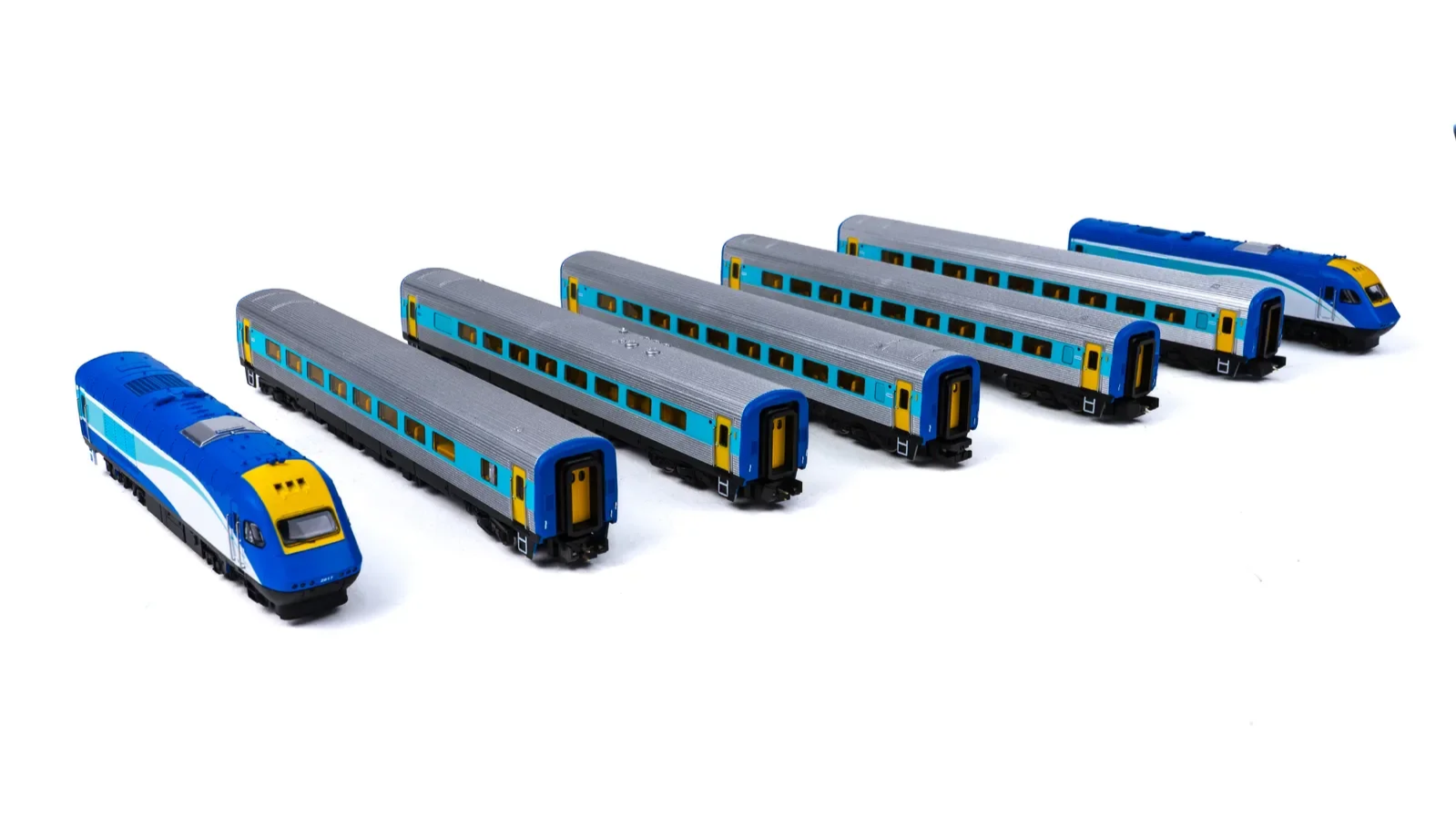
So we've done all those things in terms of I actually now basically just communicate directly with his factory and and plot out all the electrical specification of the models. So lighting features, yeah, decoder sockets and things like that stay alive in a in a you know hardware sense, and I check all the circuit diagrams and check the the models when they come in to make sure all that stuff is working as it should, and then yeah, it stretches into the to the sound project side of things, so I've I've provided sound projects for the the Gopher Models 38 class. That was it's actually not strictly my sound project for that one, but I yeah I guess project managed the sound project into that using some sound a sound project from some colleagues of mine.The XPT I went out and and so the Gopher Models XPT. I went out and and did some recordings for that. Then actually was very kindly given some recordings for that as well. So yeah, and and overall, I yeah project managed a lot of the electrical specifications of that model.
Mark Jesser: And on the XPT, I believe the DCC for that was was quite a bit of a different thought in in the sense that you've got the local at the other end that's obviously idling away at times and you'll hear it. Tell us a little bit about sort of how you sort of made that all work.
Jarryd Langford: Yeah, yeah. So I had to. Learn a lot about how the XPTs actually work in in the prototype. I yeah really to be honest had no idea. Thankfully, a member from Sydney and was actually at he's no longer, but at the time was a driver of an he was an XPT driver. So I just honestly sat down with him and just asked him a whole lot of questions and said how does how does this work? How does that work?" And then we did our very best to replicate that in the sound project itself with the factory sound XPT. For most of the models, what it looks like is we've got sound at one end, so a sound decoder at one end, and a a function only decoder at the other end, which just purely handles lighting. The more complex, like you mentioned, the more complex models we did was we offered a deluxe set where there was sound at both ends of the model, and in that case, yeah, we did we did do some extra work to to replicate some of the features of the XPT. One of the unique features of the XPT is that the driver is able to nominate either the power car that they're in or the power car at the other end of the train to provide what they call supply to the train.
So one of basically what it means is that one of those power cars will the the the prime mover or diesel engine will always sit at a higher RPM or notch in terms of driving notch position on the throttle, driving notch position, and that's to provide auxiliary power to the train. So lighting, air conditioning, power for the restaurant car, things like that, the buffet. So yeah, we were able to replicate that in the sound project, and in the case of the deluxe set, yeah, we can have it at one end. the The train will provide the power car will provide that that supply, and you can hear it. You know, one or when it comes into the station, you'll have your say your lead power car will drop right down to idle, and the other one at the back will be still revving away a little bit to provide that power. So yeah, it's one of the examples of the the features that we were able to incorporate.
Mark Jesser: Yeah, awesome, awesome. And how did you sort of become the the go to for DCC in Australia?
Jarryd Langford: Yeah, I guess I just just started doing it and did it, and and yeah, particularly I guess as I started from the very beginning working with Gopher models, and then continued and continued. Yeah, we've we've always provided DCC for them, and they're one of the I guess main going concerns in terms of DCC for forensics. Yeah, sorry,they're not. Yeah, Gopher Models is not for DCC, but yeah, Gopher Models being one of the the most sort of prolific manufacturers, I should say, of N Scale in Australia. But I guess it's also just in that the I guess the time I've I've dedicated into it, in that I've always been focused on N Scale. That's what I've been focused on since the very beginning of of running Buckambool Model Trains, and I've just been quite lucky, really, in that there are a lot of other DCC installers and and you know just generally businesses out there, but they're all very focused on HO, and they really often have no interest in looking at N Scale, or they're they're too afraid of N Scale, you know they find it too small. I've just sort of been crazy enough to to do it, and and I and I enjoy the challenge. It keeps things interesting, that's for sure.Doing some of the jobs we've done for people, so I think that's sort of how it's it's kind of gone. And yeah, now taking it full time. Yeah, I try to be very available for for doing DCC N Scale work for people, and yeah, just providing anything DCC in that N Scale space here in Australia, if if that makes sense.
Mark Jesser: With DCC being very computer based and and technology sort of space, did you have much prior experience in programming or computers to sort of that sort of kicked it all off?
Jarryd Langford: Yeah, not not really. A number of people have come up to me at shows over the years and gone,"Oh, you must be like a you know you've software engineer or you've done computers or whatever they technical things they call it at university. No, I've I've done a basic arts degree essentially, or I've done a yeah an arts and education degree. Yeah, I've just always been pretty comfortable with computers from a young age, I guess. And technology has never really scared me. I've always just been willing to have a go and learn new things, and you know, I'd encourage people to to do the same. You you can you know kind of shock yourself with what you can do if you sort of give things a go and just just try stuff and be willing to make mistakes and fail as well. No, I guess I'd just say that like I've I've guess I've gotten decently good at. At um at working out how to fit decoders essentially into trains, I don't really know how decoders work. They you know they drive the train, they turn the lights on, they the sound does this and that. I've just learnt how to how to you know do what I need to do. I yeah rely on the technical expertise somewhat often of of Zimmo, one of the the brands I stock, also ESU a little bit as well, and I just have a go and figure things out essentially.And yeah, sometimes it takes a while. Sometimes you make mistakes, but you get there in the end.
Mark Jesser: You're at the forefront, really, of DCC, what what's sort of next? Are you seeing any new things sort of coming into that DCC space?
Jarryd Langford: Yeah, I I guess I try to be. I watch a lot of YouTube, too much YouTube while I'm working away in the workshop. Just yeah, seeing what all the guys on there and guys and girls and all sorts of people are you know talking about in terms of DCC. I don't, to be honest, I don't quite really know what will be next. There's a lot of talk about LCC and people are getting excited about that, and that's just called layout command control. It's sort of just DCC is very much about like you know it's centered around locomotives and the track, LCC sort of tries to expand that to the entire layout, accessories and and also you know automations. You might have level crossing gates or whatever it be, all that sort of stuff. Yeah, LCC, I guess technically speaking, is is the the next thing, but in reality, we're not seeing a lot,at least in Australia, or really many places that I've seen. We're not seeing a lot of adoption of it. It's yeah, it's sort of quite a technical thing. DCC has has advanced a lot to a point where it's it's it's flexible enough that really anything that people want to do with it, it can handle, or you can do it without DCC. You can just get Arduinos or whatever, and and and achieve the goal that you want. So, I think in the DCC ex space, they they are moving forward considerably to produce more products, more hardware, more physical items that people can pick up. There is a throttle in the works,which we've got samples of on display at the convention here today. So that'll be something a little bit different in that we've talked a lot in on here on the podcast about in this episode about people using their phones and things like that,and that's all good and well, but I think the next step is that people have used their phones for a while, and they're probably, and I feel at least, and myself, I guess included, we're getting to the point where something maybe a little bit more dedicated would be nice in some cases, where we can have a throttle that we can hold behind our back and turn a nice wheel or something, and we can drive a train. We don't have to look at the phone where we're touching on the screen to adjust the throttle, or even you know look look on the phone where to press the button for the horn or whatever it be. So I think that's that's something that's going to grow a little bit as we move much more into the space of people running their trains on DCC using Wi-Fi quite heavily. So that's probably one of the the major next things. And yeah, perhaps we might even see other companies or people innovating in that space. But yeah, more hardware from DCCEX servo controllers and lots of different accessories and things like that, and they have a lot of vision about trying to push that Wi-Fi control forward even more. So to the point where that we're not going to have to do as much wiring under the layout. A lot of accessories and items will connect to each other and communicate via Wi-Fi rather than running some sort of a bus cable or lots of little cables to you know talk to this and that. So that's that's something that's that is also being pushed quite a bit by DCCEX, and we we may see in in the not too distant future.
Mark Jesser: Your your dad gave me a little bit of intel before you're 27 this year, turning 28. If if I'm right, yes, yes. How do we get more young people into the hobby?
Jarryd Langford: Yeah, that is a big question. Yeah, I don't know. I think I mean what I have seen is diving, I guess, a little bit into the HO space, which is one of the more dominant things here in Australia. If we're talking Australian modeling, which is definitely on the up, a lot of young guys I see are getting really keen in. They can, you know, they can go at train station on a given day. They might see a freight train. They might see a couple of passenger trains,suburban trains, whatever it be. They can then go into a model shop and buy those. And I think so. This is talking like you know modern era stuff. I think I think that has been really helpful to get young people involved into the hobby and social media as well. So you're seeing a lot of young guys and girls on social media modeling with that kind of stuff.Some of them doing old, you know, Daisy era or Steam era as well. But I think that has definitely helped. And I think so long as that continues, and this is of course these models have got you know DCC sound and all the lights work, and there's that play value in there rather than just sort of the slot car type mentality of chuck the old you know Hornby whatever on the track and it runs around. That's great, but for young people, we you know we're we're chronically online and we like technology and all this sort of stuff. A lot of us do, I guess. Having that technology available in the models and that interactivity, because again, yeah, the young generation we we're we're wanting we're wanting you know flashy fancy flashing lights and cool things interest us where you know very short attention span all that sort of stuff yeah I think that's really helping so I think as long as that continues and it and it pushes forward it's going to help keep attracting young people into the hobby and yeah I think it's just about I guess I have I have thought about it a bit in in that how do you know? How does the the random person that's on the train station going? Yeah, gee, I quite like that train. How do we advertise well to them? Well, actually, you can walk into X Y Z hobby shop, and you might see that train. You might be able to buy it, and you could get some track, and you could have it running around the kitchen table or whatever at home, and and get a little bit of satisfaction out of it, and then maybe might take it further and scenery and all this sort of thing. So I think it's yeah, it's about how we reach those people. I think probably particularly on social media and how they see oh that that stuff's actually available, particularly as as we're you know not we haven't got hobby shops in lots of suburbs and country towns and everything like we used to decades ago. So,
Mark Jesser: yeah. And are you seeing that also from behind your stand? Like, are you seeing younger people coming to sort of have those chats to how to get involved?
Jarryd Langford: Yeah, definitely, definitely. Yeah, yeah. I had a really good chat to a young guy at the Dy exhibition recently, and he was like just finishing high school, and he was super keen. I think cost is a big issue there, and like there's there's sort of no getting around that really. So yeah, I guess watch this space. Is there are some products that we are working on long term that we want to bring to market that will actually deliberately hit this kind of you know Gen Z or whatever up to Gen Alpha or something whatever we're up to now that'll really sort of hit that space where I see people are getting really keen. I've seen at least in Sydney that there's a lot of young people. I'm talking like high school age people that are super keen on you know Sydney trains and Metro and they're out filming stuff all the time. And I recently saw a heritage tour where they were retiring one of the Sydney trains' K sets, so old silver train, and couldn't believe like the number of young people that were on it. They're you know, it's pulled into the station. They've all bolted off the train and run around to the front to try and take pictures. And there, um, yeah, there was more. There was more people probably under the age of 20 than there was over the age of you know 30 on the train. Um, you know, all the way up to you know you think it'd be full of, um, you know, retired people or people that I, you know, I used to ride on that to work, and that you know that'd be that'd be fine. But no, it's it's young people that you know probably weren't even around when a you know when the the Sydney War you know Sydney trains Waratahs came out in like the mid 2000s or whatever. So they you know yeah it's it's quite amazing. So I think it's it's about how we kind of capture them because obviously train spotting is quite a cheap hobby, relatively speaking. You go to a train station, watch a train, and that counts. Not a lot of costs involved there. So how we how we get them to the point where actually you could you could own a model of that. So that's that's yeah, a few a few spitball Thoughts there,
Mark Jesser: fantastic. And future plans for you? Obviously, things are going well. You, you and your wife are working. You know, in the business full time. Have you got any future plans that you know that you want to share?
Jarryd Langford: Yeah, yeah. So long term, we we really want to get involved into. More and more manufacturing.It's a yeah real passion of mine. I really enjoy the process. Really enjoy bringing product to market. And yeah, I've been really passionate about Australian N Scale for a very very long time. And I'm doing everything honestly, yeah,everything I can basically to bring more product to market. In that, the more that there is available to buy, we figure the more people will get involved. As then, you know, that person who thought, oh, you know, maybe a go for 38, that's not for me, but oh yeah, go for XPT, for instance. Oh, yep, that's for me. So if we didn't bring that product to market, then perhaps we wouldn't, you know, have have the the people in the hobby that we do now, so definitely working forward in that space. I'd like to produce more, yeah, more ready to run items. We're probably long term hoping to pull pull away a little bit from the installation side of things, and yeah, move more to the the retail space where we're producing more models. So it'd be rolling stock. We'd like to produce locos powered powered items, yeah, all sorts of things.
Mark Jesser: Yeah, nice. Well, well, thank you very much for your time. It's it's definitely been interesting for myself,and I'm sure others listening. So, yeah, I'm looking forward to seeing what happens with you next.
Jarryd Langford: Yeah, no, thank you, Mark, and really appreciate the effort you're putting into these podcasts and everything else you do. Check out nscale.au, everyone. It's a yeah very good resource, and the Australian N Scale Facebook group, which is another fantastic place as well. So yeah, get behind what Mark's doing, guys. It's really really good. Thank you, mate. Thank you.